
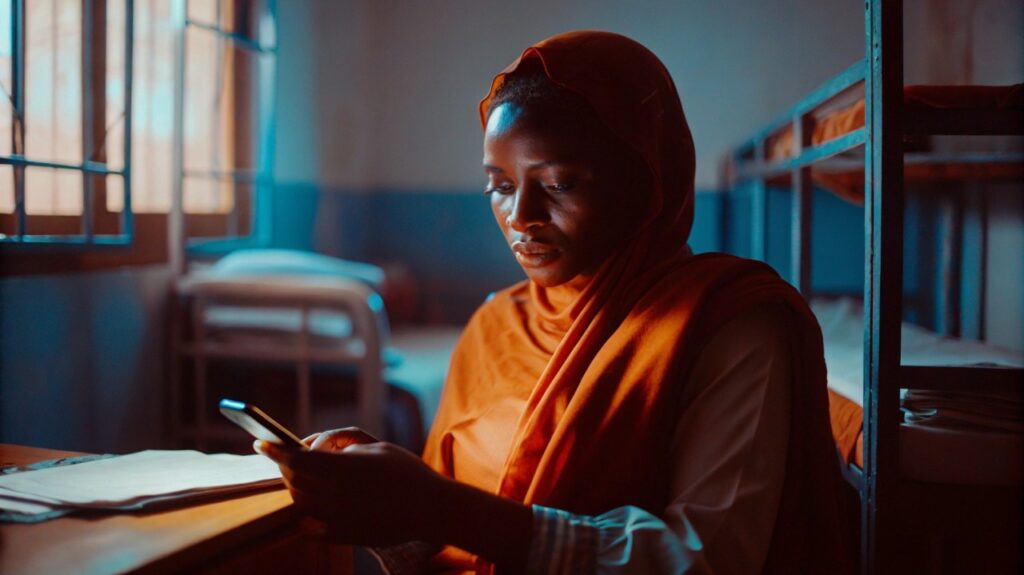
In northern Nigeria, behind every statistic is a young life, and sometimes, a child lost too soon. In Katsina State alone, 652 children died from malnutrition in the first six months of 2025, more than double the previous year’s total. UNICEF estimates nearly 3 million Nigerian children are currently battling severe acute malnutrition.
These figures point to one thing: we urgently need systems that can see trouble early, not just react once it becomes a crisis.
Why Real-Time Nutrition Data in Nigeria Needs More Than SMS
SMS-based nutrition monitoring has emerged as a quick fix. Health workers in remote clinics send weekly updates via text, recording admissions, discharges, and the use of therapeutic foods. The goal: faster reporting than paper forms.
But when researchers recently reviewed SMS systems in five northern states, a harsh reality surfaced.
In one clinic, SMS reporting suggested a 6.5% default or death rate. Physical child health cards told a different story: 22%. That’s not a rounding error, that’s a system failure.
And it wasn’t just a one-off. Both systems—SMS and paper—underperformed. The failure didn’t start at the point of reporting. It started at the source: the clinic.
What’s Really Causing the Data Gaps?
Interviews with frontline staff uncovered consistent issues:
- Staff estimated numbers instead of counting.
- Intake logs were missing or outdated.
- Some workers hadn’t been trained in months—others never.
- Reporting fatigue led to shortcuts.
Introducing SMS didn’t solve the problem, it just transmitted flawed data faster.
If you’re responsible for program funding, health outcomes, or food response planning, your decisions depend on data you can trust. Here’s how WeCollect is making that possible:

A Better Model: Local, Simple, Trusted
Imagine if, every week, trained local agents, community health workers, vendors, teachers, logged just a few simple observations:
- How many children were admitted to the clinic this week?
- Is RUTF (Ready-to-Use Therapeutic Food) still available?
- Has school meal attendance dropped?
- Are staple food prices rising?
Each log is timestamped, geotagged, and flagged if it looks off. If millet prices spike in Sokoto or clinic attendance drops in Kano, someone’s notified immediately.
That’s the WeCollect model. And it’s not hypothetical.
From Missed Signals to Actionable Data
Over the past year, WeCollect has helped field teams across Nigeria gather more than 20,000 verified data points, on nutrition, medicine access, crop health, and more.
Here’s what makes it work:
- Local agents trained in 60 minutes, no technical jargon.
- Structured data that’s simple, timestamped, and geotagged.
- Automatic flagging of outliers or inconsistencies.
- Real-time dashboards for decision-makers not weeks later.
This isn’t just a better tool. It’s a better process, one that turns field reporting from a chore into a source of clarity.
Why It Matters More Than Ever
- Nearly 40% of Nigerian children under five are stunted
- The lean season (June–September) often sees a spike in wasting
- Traditional systems break down exactly when speed matters most
We can’t keep relying on systems that are too slow to respond and too messy to trust. The cost is too high, not just in money, but in missed chances to save lives.
Join the Conversation and the Solution
We’re starting deeper conversations around what it takes to build high-fidelity nutrition data systems in Nigeria.
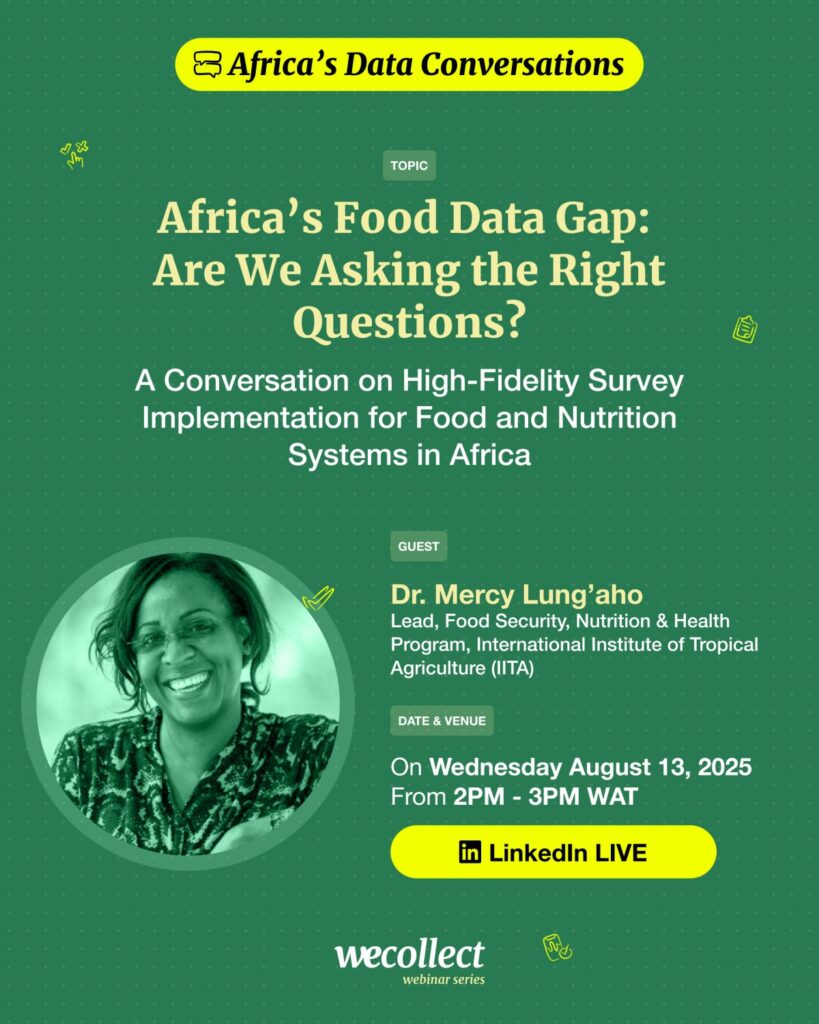
🗓️ Join us on August 13 for our next Africa Data Conversation: “Implementing High‑Fidelity Surveys for Food and Nutrition Data in Africa”
Featuring Dr. Mercy Lung’aho , Program Lead for Nutrition and Health at International Institute of Tropical Agriculture (IITA) .
Want to See How WeCollect Works?
If your organization works in nutrition, agriculture, public health, or food systems, and you’re serious about real-time response and local data you can trust, we want to collaborate.
Let’s stop reacting too late. Let’s build systems that help us act early and act smart.
