
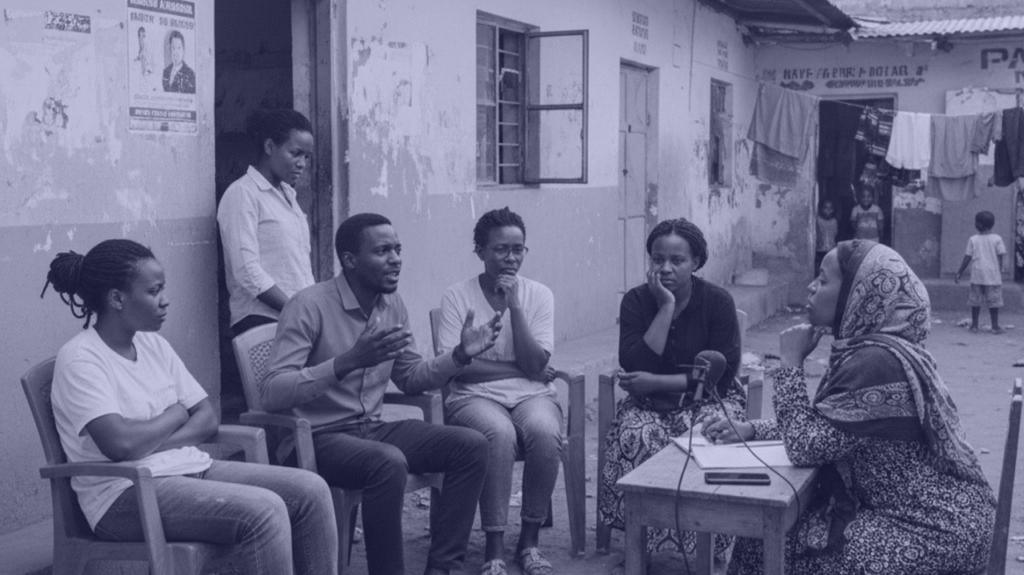
Africa’s markets are shaped by context more than categories. Trust, language, culture, and informal systems play a significant role in how people behave. This is why qualitative research remains indispensable.
Institutions such as the World Bank and the World Health Organization continue to rely on Key informant interviews and focus group discussions to understand financial inclusion, healthcare delivery, education access, and agricultural systems across the continent. The World Bank’s qualitative research guidance highlights that interviews and group discussions are critical for understanding lived experience, institutional dynamics, and social norms that quantitative data often misses (World Bank, Qualitative Research Methods, https://documents.worldbank.org).
In Nigeria, for example, the Situational Analysis of Women’s Financial Inclusion relied heavily on stakeholder interviews and focus groups to uncover trust barriers and documentation challenges that transaction data alone could not explain (Enhancing Financial Innovation & Access – EFInA, https://efina.org.ng). Similar approaches have been used in Ghanaian public health studies, where FGDs helped explain vaccine hesitancy and healthcare access issues that were invisible in coverage statistics (BMJ Global Health, https://gh.bmj.com).
The evidence is clear: qualitative research is not optional in Africa it is foundational.
The Growing Gap Between Listening and Learning
Despite its importance, qualitative research often struggles with operational challenges.
Interviews are recorded but transcribed late. Focus group discussions are summarized instead of fully captured. Local language nuances are lost in translation. Analysis begins weeks after fieldwork ends.
WHO field research guidelines acknowledge that delays in transcription and analysis can significantly reduce the usefulness of qualitative data for timely decision-making, particularly in fast-changing environments (WHO, Qualitative Methods in Health Research, https://www.who.int).
By the time insights reach decision-makers, conditions may have changed. Opportunities are missed not because people weren’t listened to, but because the system couldn’t keep up.
This gap between listening and learning is where the future of qualitative research must evolve.
What the Research Tells Us About Effective Qualitative Methods
The literature is consistent: KIIs and FGDs are most effective when they are well-designed, triangulated, and analyzed systematically.
Research methods guidance from INTRAC and the World Bank emphasizes that KIIs are particularly effective for understanding systems, policy bottlenecks, and operational realities, while FGDs are better suited for exploring perceptions, beliefs, and social influence (INTRAC, Focus Group Discussions, https://www.intrac.org).
However, these same sources warn about common risks: bias, selective note-taking, dominant voices in group discussions, and loss of nuance during transcription. These risks are not theoretical; they appear repeatedly in African research contexts where language, power dynamics, and trust play major roles.
What the literature also highlights often implicitly is that process quality matters as much as method choice.
Where Voice AI Fits Into the Future
Looking ahead, the future of qualitative research in Africa is not about replacing human interaction with technology. It is about supporting listening at scale.
Voice AI helps address three persistent challenges identified across research literature:
- transcription delays,
- loss of verbatim detail,
- heavy manual analysis workloads.
According to global qualitative research practice notes, automated or assisted transcription significantly reduces turnaround time and improves data integrity when paired with human review.
In African contexts where research is often multilingual and field-based voice-supported workflows help preserve original phrasing, tone, and emotion, which are critical for accurate interpretation.
Learning from Real African Use Cases
Looking at past research efforts across Africa helps clarify what the future could look like.
In Nigeria, financial inclusion studies by EFInA and the Central Bank of Nigeria used KIIs to understand barriers to adoption. While the insights were strong, reporting timelines were long. Voice-supported transcription could have enabled earlier synthesis and faster policy engagement (EFInA, https://efina.org.ng).
In Ghana, public health evaluations documented in BMJ Global Health show that FGDs surfaced critical community concerns, but much nuance depended on facilitator summaries. Verbatim voice capture would have strengthened traceability and interpretation (BMJ Global Health, https://gh.bmj.com).
Across multiple African agriculture and development studies, the World Bank’s ID4D qualitative toolkit highlights the value of capturing participant voices accurately to inform inclusive policy design (World Bank ID4D, https://id4d.worldbank.org).
In all cases, the insight existed. The limitation was how quickly and clearly it could be turned into action.
What Changes in Time, Quality, and Analysis
Time Voice-supported workflows reduce transcription timelines from weeks to days, allowing insights to emerge while fieldwork is still ongoing (SAGE Research Methods).
Quality Verbatim capture protects nuance, emotion, and meaning especially important in multilingual and culturally diverse African settings (WHO).
Analysis Researchers spend less time organising data and more time interpreting it, improving the depth and usefulness of insights (World Bank).
These improvements do not replace expertise, they amplify it

Looking Ahead: Africa Data Conversation with Whitney Hughes VP Partnerships for Francophone & West Africa at Viamo
The future of qualitative research in Africa will be human-led, context-aware, and responsive.
The methods will remain familiar. The conversations will remain human. But the systems around them will evolve.
Because in Africa, where context is everything, the ability to listen well and act quickly on what you hear will define the next generation of insight-driven organizations.
And that future begins with listening done better.
If you’re thinking about how all of this comes together in practice, we’re hosting a live conversation to explore it further. Together with Viamo , a leader in voice-based engagement across Africa, we’ll be unpacking how organizations are using Voice AI to listen better, move faster, and reach people at scale especially in health and education.
The webinar will share real examples, lessons from the field, and practical ways to apply voice-supported qualitative research in African contexts. If your work depends on understanding people, not just counting them, this session is for you. Join us and see what the future of listening looks like.
